TPI NYC
TPI NYC
  • Home
  • Time Perception
  • TPI
  • Login
  • About Us
  • Partners
  • More
    • Home
    • Time Perception
    • TPI
    • Login
    • About Us
    • Partners
  • Sign In
  • Create Account

  • Bookings
  • My Account
  • Signed in as:

  • filler@godaddy.com


  • Bookings
  • My Account
  • Sign out

Signed in as:

filler@godaddy.com

  • Home
  • Time Perception
  • TPI
  • Login
  • About Us
  • Partners

Account

  • Bookings
  • My Account
  • Sign out

  • Sign In
  • Bookings
  • My Account

The Time Perception Index (TPI)

What is the Time Perception Index (TPI)?


Our perception of time is informed by a series of complex internal and external time keeping systems.


 Our perception of time emerges from interacting internal and external timing systems that sometimes align and sometimes compete, producing our moment-to-moment sense of time. These systems change across the lifespan and with daily activities such as learning, movement, and consumption, and when they become extreme or misaligned, they may contribute to cognitive and mental health difficulties, including ADHD, executive dysfunction, dementia, depression, and anxiety. 


The Time Perception Index draws on existing research to model how selected factors influence these systems, offering insight into how lifestyle shapes time experience and how it can be adjusted to speed up or slow down perceived time, with potential benefits for performance, mood, attention, memory, creativity, stress management, and presence in daily life. 


CLICK HERE to check out a brief history of time perception to see where the TPI fits in!
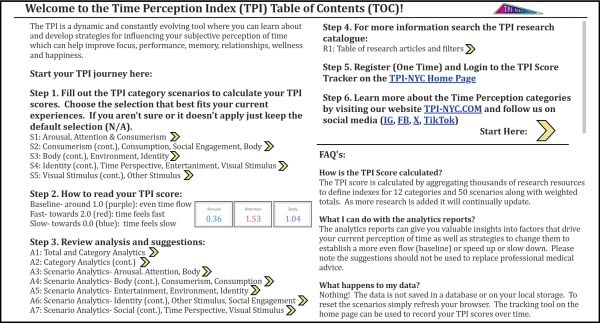
How to use the TPI

Internal (Endogenous) Time Perception Systems

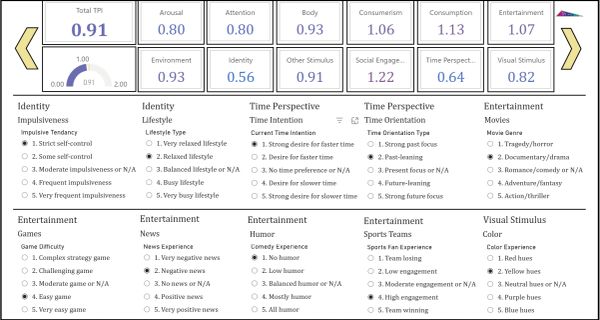
Select answers for each of the 12 categories listed that relate to internal (endongenous) time perception systems.

External (Extragenous) Time Perception Systems

Select answers for each of the 12 categories listed that relate to external (extragenous) time perception systems.

Time Perception Report Results

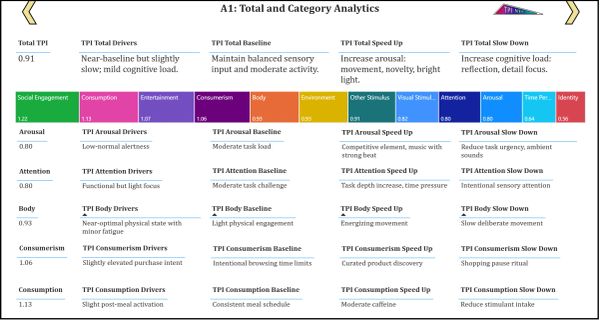
Suggestions for changing your time percption (slow down, speed up, find baseline) based on your TPI score. Take a screenshot!

Time Perception Index References

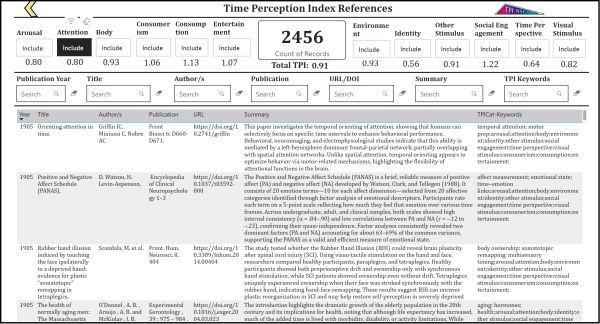
Access and filter research resources used for the TPI index calculation.

What can you do with the TPI?

TPI Applications

The TPI is primarily an educational tool to help you better control your experience of time perception.  The index score is not recorded so it remains a private experience.  You have the choice to track or take screenshots to record your score.  You can also select different choices to see how they impact your TPI score.


To get the best experience out of the TPI try to capture a score daily or at least once a week.  You may even want to share with friends and family.  As you become more aware of factors in your daily life that impact your time perception it will become easier to manage and control them as well as support others.   You can also set goals to use your time perception awareness to improve your lifestyle, optimize performance and help overcome medical challenges.

Performance

The TPI can help evaluate and improve performance from fitness and sports to business and arts by revealing changes in arousal, attention, and cognitive load that affect pacing, decision-making, learning, and stress. By making subjective time awareness explicit, people can better align effort with task demands, optimize focus and skill acquisition, prevent burnout, and reduce impulsive errors under pressure.   It can also be used as a metric to measure performance goals or shared temporal experiences.

Lifestyle

The TPI can be used to continually improve general lifestyle experiences including managing stress, relationships and career goals.  It can reveal how stress, fatigue, engagement, and habits shape daily experience, helping people detect overload, improve balance, prioritize meaningful activities and support recovery.  The TPI can also help highlight which activities enhance or drain well-being and cause lifestyle strain early through changes in sleep and health-related factors along with promoting mindfulness and presence, supporting greater balance, satisfaction, and emotional regulation. 

Medical

The TPI can help improve medical problems by revealing early changes in mental and physical states, supporting diagnosis and monitoring, personalizing treatment, and enabling better self-regulation and long-term management of symptoms. Distortions in time perception are linked to many conditions—such as depression, anxiety, ADHD, PTSD, chronic pain, sleep disorders, and neurological disease. By monitoring whether time feels consistently rushed, slowed, fragmented, or blunted, clinicians and patients can detect early warning signs of symptom worsening before objective measures change. 

Ready to start?

Registration required
Go to the TPI

Copyright © 2026 TPI NYC - All Rights Reserved.

Powered by

This website uses cookies.

We use cookies to analyze website traffic and optimize your website experience. By accepting our use of cookies, your data will be aggregated with all other user data.

Accept